Finance is a mysterious industry, I believe the whole industry builds on top of the necessity of the fundamental finance problem.
Finance truly embodies the ultimate truth that of “Knowledge is Power”, seeing how operators moves (playing sophisticated games with enormous stakes, only those with skin in the games btw.) with knowledge edge. It’s both beautiful, and deadly / corrupted. It’s dark yes, but it’s a necessity.
Yet, the goal with this writing is to simply demystify the finance in it’s overall, what is it, what does it’s comprise of, and how can we proactively understand it deeply.
Let’s first establish the model. I called this model PMOFTP Model. A bit long but I like how it sounds. The long word for it is Practical Manifestation of Finance Theoretical Problems.
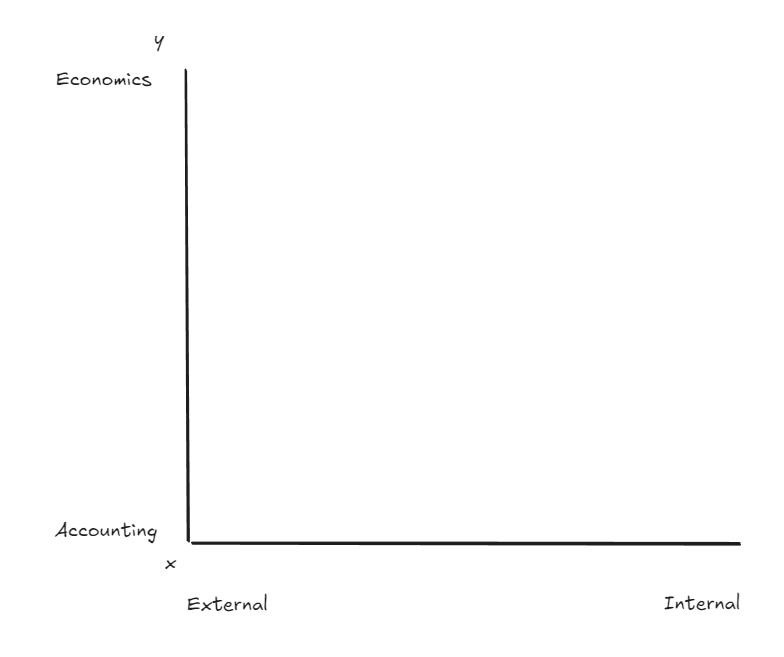
When I thought of this model, I’m trying to understand the application and construction of the model. Let’s first establish that.
The Y-axis implied construction, economic(top) to accounting(bottom). The X-axis implied application, external (left) to internal (right).
Now we have some foundation to lay on. We can read further on their logic to understand their rationale behind the spectrum.
Next, the understanding of it’s matrix.
Using scopes/focuses and objectives as main principles for the classification, we can classify it this way.
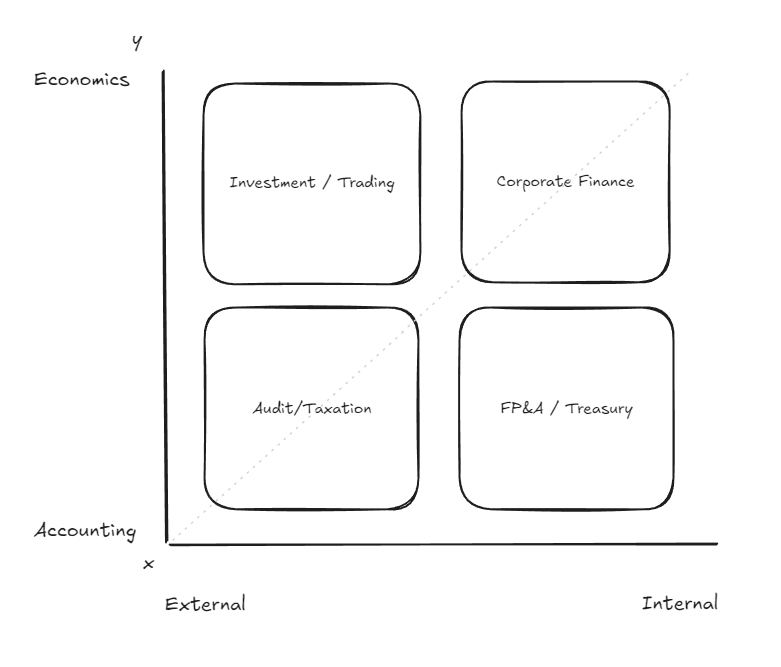
- Top Left - (Economics + External): Investment/Trading.
- Scope/Focus: Financial markets, securities, trading strategies, market analysis.
- Objectives: Generate returns, manage market risk, capitalize on market opportunities
- External orientation: Market-driven decisions, external benchmarks, competitor analysis
- Top Right - (Economics + Internal): Corporate Finance.
- Scope/Focus: Capital structure, strategic investments, M&A, long-term value creation
- Objectives: Maximize firm value, optimize capital allocation, strategic growth
- Internal orientation: Company-specific strategy, internal stakeholder value, strategic decisions
- Bottom Left - (Accounting + External): Audit/Tax.
- Scope/Focus: Tax regulations, compliance requirements, tax planning strategies
- Objectives: Minimize tax burden, ensure compliance, manage tax risks
- External orientation: Regulatory-driven, external authority relationships, statutory requirements
- Bottom Right - (Accounting + Internal): FP&A + Treasury.
- Scope/Focus: Internal performance measurement, budgets, forecasts, variance analysis, cash flows, liquidity management, and internal financial operations.
- Objectives: Support management decisions, track performance against plans, resource allocation, ensure operational continuity, maintain adequate liquidity, optimize working capital
- Internal orientation: Company-specific metrics, management reporting, operational planning, company-specific cash needs, internal reporting, operational efficiency
Lastly, I believe we’ve fundamentally map out what is there inside a financial industry.
What we need next is to enrich this model, so we can:
- Navigate the world of theory with this model.
- Build expertise, specialized and details for each of it’s component.
- Navigate the world of practical with model’s principles.
Here are more writings basing on this derivatives “pun intended”.
- Information flows within the system.
- Process in it’s overall.
- Major and Minor relationship within the system.
- Internal Infrastructure - case study
- Relationship outward the model (relating to growth and people)
- Relationship inward (relating to philosophy and fundamentals)
Reference: