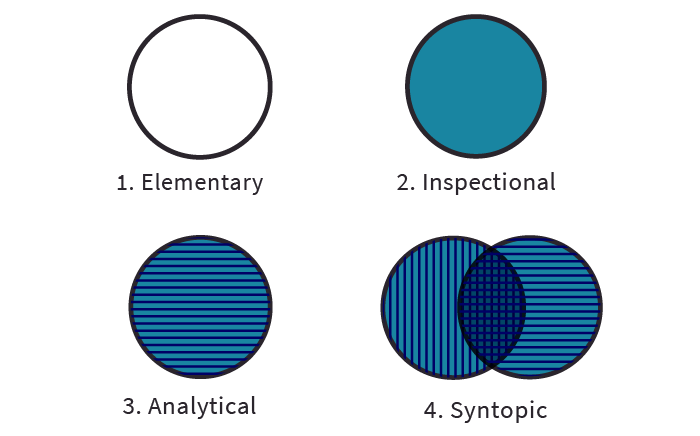
Extension to Inspectional Reading: Systematic Skimming
Skimming or pre-reading is the first sublevel of inspection reading. Your main aim is to discover whether the book requires a more careful reading. Secondly, skimming can also tell you lots of other things about the book even if you decided not to read it again with more care.
Giving a book this kind of quick once-over is a threshing process that helps you to separate the chaff from the real kernels of nourishment. You may discover that what you get from skimming all the book is worth to you for the time being. It may never be worth more. But you will know at least what the author’s main contention is, as well as what kind of book he has written, so the time you have spent looking through the book will not have been wasted.
LOOK AT THE TITLE PAGE AND, IF THE BOOK HAS ONE, AT ITS PREFACE. Read each quickly. Note especially the subtitles or other indications of the scope or the aim of the book or of the author’s special angle on his subject. Before completing this step you should have a good idea of the subject, and, if you wish, you may pause for a moment to place the book in the appropriate category in your mind. What pigeonhole that already contains other books does this one belong in?
STUDY THE TABLE OF CONTENT to obtain a general sense of the book’s structure; use it as you would a road map before taking a trip. It is astonishing how many people never even glanced at a book’s table of content unless they wish to look something up in it. In fact, many authors spend a considerable amount of time in creating the table of content, and it is sad to think their efforts are often wasted.
CHECK THE INDEX if the book has one - most expository works do. Make a quick estimate of the range of topics covered and of the kinds of books and authors referred to. When you see terms listed that seem crucial, look up at least some of the passages cited.
If the book is a new one with a dust jacket, READ THE PUBLISHER’S BLURB. Some people have the impression that the blurb is never anything but sheer puffery. But this is quite often not true, especially in the case of expository works. The blurbs of many of these books are written by the authors themselves, admittedly with the help of the publisher’s public relations department. It is not uncommon for authors to try to summarize as accurately as they can the main points in their book. These efforts should not go unnoticed. Of course, if the blurb is nothing but a puff for the book, you will ordinarily be able to discover this at a glance. But that in itself can tell you something about the work. Perhaps the book does not say anything of importance - and that is why the blurb does not say anything, either.
From your general and still rather vague knowledge on the book’s content, LOOK NOW AT THE CHAPTERS THAT SEEM TO BE PIVOTAL TO ITS ARGUMENT. If these chapters have summary statements in their opening or closing pages, as they often do, read these statements carefully.
Finally, TURN THE PAGES, DIPPING IN HERE AND THERE, READING A PARAGRAPH OR TWO, SOMETIMES SEVERAL PAGES IN SEQUENCE, NEVER MORE THAN THAT. Thumb through the book in this way, always looking for signs of the main contention, listening for the basic pulsebeat of the matter. Above all, do not fail to read the last two or three pages, or, if these are an epilogue, the last few pages of the main part of the book. Few authors are able to resist the temptation to sum up what they think is new and important about their work in these pages. You do not want to miss this, even though, as sometimes happens, the author himself may be wrong in his judgment.
Extension to Analytical Reading: There are four rules to follow,
- Divide the books according to the subject matter
- Compactly state what the book is about
- Identify its major parts and outline these parts
- Determine the problem the author is trying to solve
Inspectional reading has primed you for this, therefore, the task becomes easier.
Extension to the Understanding Francis Bacon’s essay “Of Studies” (1625):
“Some books are to be tasted, others to be swallowed, and some few to be chewed and digested.”
Extension to the Elementary Reading. Mills Fintz illustrates the reading process as follows: (1) Word perception, (2) Comprehension, (3) Reaction and (4) Integration. Word perception requires proper eye movement, identification of printed symbols and their intended meaning, reading speed, and decoding skill. Comprehension on the other hand, requires an identification of the main idea, the specific details, sequence and directions to be followed. It also involves the skill of making inferences, sensing relationships, drawing conclusions and recognizing the author’s purpose and feelings. When comprehension is fully recognized, a reaction follows. This step includes the ability to judge the accuracy, quality and worth of what was understood. Once ideas are accepted and become a part of a reader’s total experience, the assimilation or integration process takes place. In this stage, new ideas are integrated and become part of all past related experiences.
Reading is a basic tool for learning in all subject areas. If one think reading is a simple process, he is definitely wrong. If you are able to finish a book and understand its content, you have just undergone a complex process which involves different skills and abilities. Unless one has developed these elementary skills and abilities, academic life will surely be a burden.
References: