Summary: “The Start-Up J Curve” discusses the common misconceptions and challenges faced by entrepreneurs during the various phases of a start-up. It emphasizes the importance of iterating on ideas, listening to feedback, and adapting to market demands rather than sticking rigidly to the original plan. The document highlights the significance of timing, the need for realistic expectations, and the dangers of scaling too quickly before establishing a solid business model. Entrepreneurs are advised to focus on customer traction, product/market fit, and making informed decisions to navigate the unpredictable journey of entrepreneurial success.
Highlights
a start-up unfolds in a predictable pattern; the more aware you are of this pattern, the better able you will be to capitalize on it. Instead of feeling lost and confused when you suffer a setback—something that happens to start-ups quite frequently in their initial stages—you’ll be able to put these problems in context. This is not only psychologically reassuring but also helps you know what to do—and what not to do—at a particular moment in time. By knowing exactly where you are on the path, and what to do at that point in time, your odds of success will increase, and you will get to success faster. (View Highlight)
As veteran investors, however, David and I had learned that the original plan almost never works. In fact, it’s my belief, backed up by many conversations with start-up veterans, that drastic (not incremental) revisions to the original business plan happen in over 80 percent of successful start-ups. (View Highlight)
KNOW WHERE YOU’VE BEEN, WHERE YOU ARE, WHERE YOU’RE GOING (View Highlight)
The value of this book is that it will help you become familiar with the start-up path. It will show you the markers along the way that will identify your particular point in the process and the best actions to take at this point. You’ll learn, for instance, what to do when your initial product falters—a common start-up occurrence. You will also learn when to use the knowledge gleaned from the failing product to introduce iterative—and eventually, more successful—versions of the original. (View Highlight)
Once you know where you are on the start-up path, you are much better able to know what your next steps should be—as well as the common (but avoidable) mistakes often made at a particular point on the path. This knowledge is hugely valuable tactically, but it’s equally important psychologically. (View Highlight)
some entrepreneurs take enormous and often unnecessary risks because they are caught up in the start-up mentality; they believe they must be overly aggressive if they’re going to be successful. In fact, there are times to be aggressive and times to be conservative, and if they know where they are on the start-up map, they can respond appropriately. (View Highlight)
As we reflected and discussed the situation, we recognized that we had proven at least one of our hypotheses: There was a huge untapped work-from-home labor market. They wanted and needed good jobs. (View Highlight)
Note: Not working, doesn’t mean all of it is null/not working.
There is some ticks that can be check.
What I came to realize, however, is that the entire journey is a process. The product and associated business model is really simply a hypothesis (not a hard-and-fast product launch), and the results are not pass/fail or black and white, but instead produce feedback, providing essential information that increases the odds of success. I had an epiphany: Iterations count more than the original idea, feedback counts more than the sales numbers, and flexibility and agility are more important than commitment to the original idea. (View Highlight)
Note: Important
THE SIX PHASES OF THE J CURVE
The shape of this six-phase curve suggests what differentiates it from other start-up models. (View Highlight)
Note: Anticipate
Release and Morph
At first, the power of the business idea captures everyone’s imagination, and it garners money, team members, and other forms of support. (View Highlight)
Note: This is where feasibility, and team building happened
reality sets in, products take longer to develop than expected, customers don’t embrace the initial offering the way that was anticipated, the business model doesn’t quite work, and eventually money starts drying up. These are all tough hits to take, especially if you’re not prepared for them. Therefore, the dip is represented by the base of the J, and it’s where startups figure it out or they die. I call it the long, cold winter or, if I’m feeling more morose, the valley of death. (View Highlight)
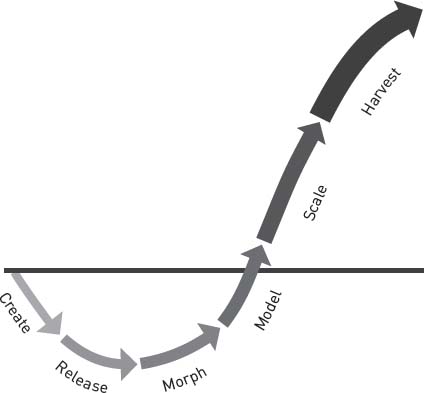 The shape of this six-phase curve suggests what differentiates it from other start-up models. (View Highlight)