Summary: The document emphasizes the importance of understanding and measuring financial results in business to pinpoint areas for improvement. It stresses the significance of converting revenues into profits and then into cash flow efficiently. By mastering the financial analysis tools and strategies outlined in the blueprint, business owners can enhance profits and cash flow without solely focusing on increasing revenue. The key lies in effectively managing assets, expenses, and revenues to ensure sustainable financial success and positive operating cash flow.
Highlights
I also meet a lot of entrepreneurs whose primary focus is on getting rich. That’s a shortsighted goal. The goal of owning a business isn’t just to be successful, it’s to be successful and stay that way. I have no interest in being successful for a week (or healthy for three days or in a great relationship for a month). I want what I want for the rest of my life. (View Highlight)
Note: It’s important to have a really good goal that is compatible with your personality and life. Build a business for life, don’t live for your business.
It turns out the key to all this learning, practicing, and sustainability revolves around the ability to measure. If you want to sustainably succeed in business, you must learn how to measure your financial results, identify the activities that are sabotaging them, and then know how to correct those mistakes so that the results you desire can be achieved. Ultimately, how much you have to spend has very little to do with what you make and everything to do with what you keep. (View Highlight)
Note: Key of operating a sustainable business revolves around the ability to measure?
As a business owner, you might get an accounting report card every month (or at least you should be getting this report card monthly, preferably by the tenth of the month). Unfortunately, business owners are notorious for their inability to understand their accounting report cards. They spend tens of thousands of dollars each year on accounting and bookkeeping, and all they get is a tax return. What a waste! (View Highlight)
Note: Monthly accounting report card.
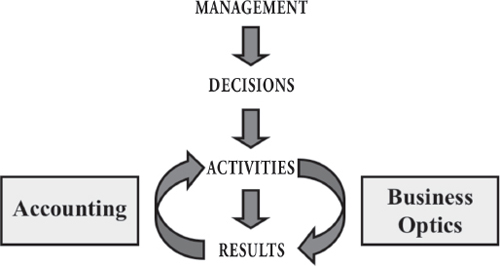
Your financial results are simply a numerical reflection of the business decisions and operating activities in your business. (View Highlight)
Note: Accounting is an “abstraction” of your business. It’s a snapshot of your business performance.
Note: Great visualization of how that “snapshot” are made of
In other words: Good Activities = Good Numbers. Bad Activities = Bad Numbers. I’ll be more blunt: Good Management = Good Numbers. Bad Management = Bad Numbers. (View Highlight)
Note: Maybe, management are all about numbers, and decision making.
My experience is that business failure is more often a result of a bad business owner than a result of a bad business. Don’t believe me? Take a look at your industry and count the number of businesses that are knocking the cover off the ball. Sure, there are some differences between your product and theirs. They are in a different location than you and might have more money in their bank account. You are better in some areas, and they are probably better in others. But the primary difference between you and your competition is you and your management team. (View Highlight)
Note: If businesses behaves like a sport team, “management” vs. “management”, that’s a hell of a mental model.
So why isn’t there a secret formula for business? Well, unlike sports, where the boundaries of the field or width of the goal posts never change, the environment for business is always shifting. A good idea a year ago could be a bad idea today. The only constant in business is change, which is why business is an intellectual sport. (View Highlight)
Note: A great reminder that game of business are far more complex and interesting from a game of football.
Matter of fact, game of business has their own variable.
Leverage is simply any tool, technique, or process that allows you to do more with less. One form of leverage is other people, or “OP.†The most famous example used in business is “OPM†or “Other People’s Money.†The reality is that there are many other forms of “Other People†leverage, such as other people’s time, other people’s networks, other people’s resources, other people’s customers, or other people’s brains. (View Highlight)
Note: “Other People’s” leverage.
Systems are another form of leverage. Unfortunately, some people make the mistake of over-systemizing their business. Systems are notorious for draining flexibility and passion from a company. Think of the employees at McDonald’s, and you’ll see what I mean. McDonald’s is the most systematized business in the world and it’s the one-trick pony the systems freaks trot out to justify their “systems are the holy grail†concept. If you only need your employees’ arms and legs, systematize away. But if you need their heads and their hearts, be gentle in how aggressive you are with systems. Used in moderation, they can be a great form of leverage. (View Highlight)
Note: System shouldn’t replace human. The leverage power that was produced by a system should be held as “empowering”.
Imagine this, if your system require “Human Labor” as input, the system should Empowered them, outputting 10x.
That’s what a good system looks like.
One of my earliest and most important lessons was this: What costs me money is what I don’t see. (View Highlight)
Note: Important Lessons:
What I don’t see.
Faulty assumption
I’m a big fan of measuring. Of course, you can overdo measuring, too. You can take it to its illogical extreme and start measuring too much or too frequently or even measuring things that aren’t meaningful. But knowing what, how, and when to measure is one of the highest forms of leverage, because that is the only way to know whether or not what you’re doing is producing the desired results and moving you in the desired direction. Measuring is the primary key to sustainability. You can’t sustain something unless you know what’s working and what isn’t, and the only way to know for sure is to: (View Highlight)
Note: Measuring time
All my problems started out as good ideas. How about yours? (View Highlight)
Our problem is not that we don’t have enough opportunities to make money. Our problem is that we have too many opportunities to lose it. In fact, one of the biggest problems with being rich is that the number of ways you have to lose money expands exponentially. It’s easier than you imagine to self-sabotage your wealth, especially if you’re ignorant about your assumptions. (View Highlight)
Note: Don’t lose money,
and measure your “thinking time”
Thinking time allows me to sidestep problems before they arise, or to identify the root cause of problems, if I haven’t already dodged them. Measuring is the tool that allows me to face reality and correct the activities that are causing my problems. (View Highlight)
Note: Set your thinking time, to do this.
My experience is that businesses that create and sustain success have an owner and management team who: (View Highlight)
Note: What a management team should do.
Anyone who doesn’t want to measure doesn’t want to be held accountable. (View Highlight)
Leverage takes many forms, but the two most powerful for any business owner are thinking and measuring. Both take time. Both require practice to master, but the results are stunning. Schedule some thinking time on your calendar this week. Question your assumptions. Think about the real problem. Set aside some time to start candidly facing the reality of your business by measuring your results and reverse engineering those results to find the activities that need to change. (View Highlight)
Note: Important To-Do
It can happen to you. Here’s why. The only constant in business is change. The business environment, competition, consumer preferences, key suppliers, interest rates—they’re all constantly changing and the speed of change is accelerating. Sustainability is impossible without measurement. (View Highlight)
Note: If everything is changing, don’t measurement of the business also changing?
Having it measured is great, cause it can gives you early signal of changes, but won’t that measurement be obsolete?
Charles Darwin’s manifesto on the theory of evolution is about “survival of the fittest.†However, the fittest does not mean the strongest, biggest, smartest, or richest; it means the most adaptable and the most flexible. Flexibility and adaptability—in nature or in business—require paying close attention to the environment, knowing exactly where you are, being acutely aware of what is and what isn’t working, and changing whatever is necessary to survive and thrive. If you do what you have always done, you will fail. (View Highlight)
Note: Survival of the fittest, adaptability and flexibility.
This itself is a muscle.
Also, hire those with ADHD, they got the most muscle for flexibility and adaptability.
That’s why anyone who is a master at what they do is a measurement freak. Peyton Manning. Oprah Winfrey. Warren Buffett. They’re always measuring, comparing and tweaking. If you read Buffett’s annual report to shareholders, you’ll see the whole thing is filled with measurements and comparisons: How he’s doing today versus how he did last year. This quarter versus the same quarter a year ago. Month over month. Current performance versus projected performance. Buffett understands that the slightest numerical variation can mean the difference between stupendous success and catastrophic failure. (View Highlight)
Note: Measurement Freak
At its most basic, business optics relies on measuring the trends and relationships between the numbers … knowing what to measure, how to measure, what it all means, and what to change so that the appropriate problem is identified and the offending activity is corrected. In a nutshell, measure the effect and change the cause. It’s that simple. (View Highlight)
Note: Great way to see how measurement process work, and a great way to understand the concept of measurement.
To us it is. But that’s only because we know the cause-and-effect relationship that allows us to adjust our nutritional activities to change our weight results. If you don’t know anything about nutrition or dieting, you won’t be able to draw a direct line from those Krispy Kremes to your weight gain. You may decide to wear different color socks or start watching television with your shirt turned inside out in an attempt to burn off those extra calories. “Maybe this will work!†you think, blindly lurching from one scheme to another, hoping that you’ll get on the scale and discover that those 5 pounds have magically disappeared. You don’t know what to change to get different results. (View Highlight)
Note: What would happened if you don’t understand the cause-effect relationship of an event?
If you persevere long enough, you might eventually stumble onto the right combination, but it’s going to take forever. And that’s exactly the kind of haphazard, random action that wears out business owners. They are simply guessing and second-guessing, which is exceptionally time-consuming, mind numbingly frustrating, and ultimately useless. They’re stressed and exhausted because they don’t know how to locate and prioritize the activities (causes) that will then produce the desired results (effects). (View Highlight)
Note: This what makes progress seems hard.
When all trial and errors are made without a strong causes-effects, we cease each execution with failures.
Turning progress into stale/stagnant painful action.
Most business owners are frustrated because they see the results, but they don’t have a clue about the activities that caused them, so they don’t know what to change. They have no idea how much money they’re leaving on the table as a result of not correcting an underlying problem. They cannot prescribe the right medicine until they accurately diagnose the disease. (View Highlight)
Attempting to create business success by solely relying on the growth lever is a little like trying to become Mr. Universe by entering a hot dog-eating contest. You may get bigger, but it’s highly unlikely you’re going to win the title you want. So why do so many business owners and entrepreneurs obsess about size and speed? There are three primary reasons: (View Highlight)
Note: Why businesses needed more than just sales and marketing.
The goal is not to get big. The goal is to create sustainable success. And you can become really, really successful being really, really small. And you can go really, really broke becoming really, really big. (View Highlight)
Note: Small is beautiful.
Fast, iterable success are much important than Fast, top-of-the-funnel success (sales).
Sales are not the answer for all.
The great business owner has a cockpit full of dials and levers. He or she knows there are a number of things to test and measure; it’s not just about going full speed ahead. Growing your business in the absence of clear optics is an accident waiting to happen, whereas if you become efficient and optimize your results and then grow your business, you just might grow rich. As Warren Buffet says, “I would rather own a 10millionayearbusinessmaking15percentthana20 million a year making 5 percent.†That’s what I call playing to win. (View Highlight)
Note: Quoted: “Playing to Win”.
But the data is true, small and profitable.
Are much better than big, and slow.
The trick is to learn how to translate that language into something that’s usable. It’s an accountant’s job to convert activities into numbers and then put those numbers on the three financial “report cardsâ€â€”the balance sheet, the income statement, and the cash flow statement. Those report cards, however, don’t tell you which answers you got right, which ones you got wrong, or what to do to get a better grade. You’ve got data but no optics. (View Highlight)
Note: Business Owners make money due to their skills of translating business language into business activities.
Accountant provide those data, and helps you understand the language better. It’s transcription problem.
If you’re not happy with the numbers you’re getting, the question has to be this: What activities need to change in order to produce better results? There is no way to win this game by guessing. (View Highlight)
“If you can’t read the scoreboard, you don’t know the score. If you don’t know the score, you can’t tell the winners from the losers.â€
—Warren Buffett (View Highlight)
The purpose of business optics (which is not the role of most business accountants but is your job as the business owner) is to take those numbers and turn them back into activities. If you don’t know what the activities were that caused the numbers in the first place, you have no shot at correcting the problem. (View Highlight)
Note: Translating those numbers into business activities are called “Business Optics”.
The real solution lies in knowing which direction the things are headed, where they should be, and what activities need to change in order to move the numbers in the right direction. (View Highlight)
Note: Important Principles
I am making a very important point here: Ultimately business optics come down to two things: (View Highlight)
Note: Important:
How do we turn these numbers into business activities?
Comparing trends (understand what happen?)
Relationship (cause-effect)
Understanding the measurements, identifying the real problems, and knowing precisely which levers to pull and dials to turn is critical to radically accelerating your profits and cash flow. (View Highlight)
Business optics and financial intelligence start with multiple points of comparison over numerous time periods. (View Highlight)
To be meaningful, these comparisons must be on a single piece of paper or spreadsheet. Comparing this month’s income statement to last month’s is a pretty good comparison. But an even better comparison would be to compare this month’s income statement with last month’s and the month before. And even better than that would be to compare this month to last month to each of the six months before that. (View Highlight)
Note: Comparison and trend is the key of using data and measurement as decision making tools.
It work like a puzzle.
Without multiple points of comparison, I have no optics, rendering my financial statements useless. Your balance sheet, income statement, and cash flow statement all must display multiple time periods, side by side, to be meaningful. Trend analysis is the first component of business intelligence. The trend is your friend. (View Highlight)
Note: Trend is your friend
The second key to business optics and financial intelligence is to display your income statement in four different formats: (View Highlight)
Note: Setting Up Your Income Statement
Trend analysis allows you to figure out where you’re getting better, where you’re getting worse, and how much money you’re leaving on the table as a result of not fixing the problems. Organize all your income statements into one spreadsheet. Set up all your balance sheets onto a second spreadsheet. Put all your cash flow statements onto a third spreadsheet. And make sure you have all three. Most business owners don’t receive all three accounting report cards, and if they do, they never look at them. Don’t fall into the trap of thinking that what you don’t see can’t kill you. It can, and it will—and it hurts. (View Highlight)
Note: Seeing trends not only help you to use past performance as benchmark vs. today.
It also helps you to identify momentum (spot pattern in loss and increase in momentum), patterns of organization, culture, and stories behind it.
Profits are a result of how efficiently management is controlling the expenses on a given amount of revenue. Revenues are a result of how effectively management is utilizing the business’s assets. (View Highlight)
Note: Interpreting numbers: (Revenue and Profits)
Some businesses are “service†(versus bricks-and-mortar or manufacturing), and therefore have very few physical assets on the balance sheet in the things and stuff section. For these kinds of service businesses (and for most others as well), the single most important asset we have is our people or employees. If you stop to think about it, the primary role of our employees is also to produce revenues or to service the revenues we receive, and thereby, help us to produce more profits.
So, the purpose of assets is to produce revenue and the purpose of revenue is to produce profits.
The Ultimate Blueprint for an Insanely Successful Business is to acquire (or employ) assets that are highly effective at producing revenue and then efficiently convert those revenues into profits. (View Highlight)
Note: Simple Pimple breakdown of how Business System work.
So here is The Ultimate Blueprint for an Insanely Successful Business:
It looks simple, but what it really means is that you need to be very effective at acquiring assets that maximize and service revenue, then be very efficient at converting those revenues into profits, and finally be very productive at converting profits into cash flow. (View Highlight)
Note: Simple Pimple
When it comes to the blueprint for your business, you have to pay close attention to not only the size of each number but also the growth rates. You don’t want—on a percentage basis—assets to grow faster than your revenues. If this happens, your assets are becoming less and less effective. You don’t want your revenues—on a percentage basis—to grow faster than your profits. When this happens, your revenues are becoming less and less efficient. And you don’t want your profits—on a percentage basis—to grow faster than your operating cash flow. If this is the case, your profits are becoming less and less productive. Obviously there could be short periods of time where one of the above scenarios occurs, but in the long term, any of the above trends are deadly. (View Highlight)
Note: Understanding the dynamics of the business system
As an example, we’d like to have our assets (or number of employees or payroll dollars) remain constant, but have our revenues grow by 10 percent, our profits grow by 20 percent, and our operating cash flow grow by 30 percent. That’s a well-run business. A poorly run business would be where assets (or number of employees or payroll dollars) grow by 50 percent, revenues grow by 10 percent, and profits only grow by 2 percent, leaving operating cash flow to stagnate or, even worse, decrease. (View Highlight)
Note: Reasons why Agency failed.
At the end of the day, we want to minimize the monetary amount of assets required to produce the maximum amount of revenue. Once we have revenue, we want to minimize our expenses to maximize our profits. Finally, we want to maximize the cash that our profits produce. (View Highlight)
Note: An Ideal business looks like
Overspending on assets and expenses sabotages your business and financial success. (View Highlight)
Note: Pimp Factor: The Sabotaging Biases business owners havee
To make this easier to grasp, assume you had to write the check to acquire these assets to produce these revenues and profits. If Business A has 1,000,000inassetsthatwillproduce500,000 of revenues and 100,000ofprofits,andBusinessBrequiresonly10 in assets to produce 500,000ofrevenuesand100,000 of profits, I’ll take the 10dealeveryday.Yourbanker,ontheotherhand,wouldloveforyoutohaveBusinessAsotheycouldjustifyloaningyoumoneyagainsttheseassets.Idona^€™thappentobeinbusinesstomakemylendersrich.Andifyoufinda10 asset with this kind of revenues and profits, please give me a call! (View Highlight)
Note: Businesses that make money (revenue and profit) with less assets are really a great business.
Warren Buffett, the greatest business and investing mind of our time, has it figured out. Buffett’s company, Berkshire Hathaway, has an estimated value of 200billionandemploysover260,000people.Inhisannualreportfor2010,BuffettrevealedtoshareholdersthathistotalexpendituresonofficeequipmentatthehomeofficeinOmahaoverthepreviousforty−fiveyearswere301,363. That’s not what he spends each year. That’s the total that Buffett invested in furniture, computers, printers, artwork, you name it, over forty-five years. I know business owners whose companies are only worth $2 million, and they’ve spent more than Buffett in the past six months on artwork and personal vehicles alone. (View Highlight)
Note: Crazy, but this is what a good business looks like.
Such a great operation.
 The goal of owning a business isn’t just to be successful, it’s to be successful and stay that way. I have no interest in being successful for a week (or healthy for three days or in a great relationship for a month). I want what I want for the rest of my life. (View Highlight)
 If you want to sustainably succeed in business, you must learn how to measure your financial results, identify the activities that are sabotaging them, and then know how to correct those mistakes so that the results you desire can be achieved. Ultimately, how much you have to spend has very little to do with what you make and everything to do with what you keep. (View Highlight)
 Your financial results are simply a numerical reflection of the business decisions and operating activities in your business. (View Highlight)
 (View Highlight)
 My experience is that business failure is more often a result of a bad business owner than a result of a bad business. Don’t believe me? Take a look at your industry and count the number of businesses that are knocking the cover off the ball. Sure, there are some differences between your product and theirs. They are in a different location than you and might have more money in their bank account. You are better in some areas, and they are probably better in others. But the primary difference between you and your competition is you and your management team. (View Highlight)
 The only constant in business is change, which is why business is an intellectual sport. (View Highlight)
 What costs me money is what I don’t see. (View Highlight)
 But knowing what, how, and when to measure is one of the highest forms of leverage, because that is the only way to know whether or not what you’re doing is producing the desired results and moving you in the desired direction.
  Measuring is the primary key to sustainability. You can’t sustain something unless you know what’s working and what isn’t, and the only way to know for sure is to: (View Highlight)
 Our problem is not that we don’t have enough opportunities to make money. Our problem is that we have too many opportunities to lose it. In fact, one of the biggest problems with being rich is that the number of ways you have to lose money expands exponentially. It’s easier than you imagine to self-sabotage your wealth, especially if you’re ignorant about your assumptions. (View Highlight)
 Thinking time allows me to sidestep problems before they arise, or to identify the root cause of problems, if I haven’t already dodged them. Measuring is the tool that allows me to face reality and correct the activities that are causing my problems. (View Highlight)
 Sustainability is impossible without measurement. (View Highlight)
 If you do what you have always done, you will fail. (View Highlight)
 business optics relies on measuring the trends and relationships between the numbers … knowing what to measure, how to measure, what it all means, and what to change so that the appropriate problem is identified and the offending activity is corrected. In a nutshell,
  measure the effect and change the cause. It’s that simple. (View Highlight)
 To create the results you desire (View Highlight)
 “If you can’t read the scoreboard, you don’t know the score. If you don’t know the score, you can’t tell the winners from the losers.â€
—Warren Buffett (View Highlight)
“If you can’t read the scoreboard, you don’t know the score. If you don’t know the score, you can’t tell the winners from the losers.â€
—Warren Buffett (View Highlight) The real solution lies in knowing which direction the things are headed, where they should be, and what activities need to change in order to move the numbers in the right direction. (View Highlight)
 Ultimately business optics come down to two things: (View Highlight)
 Understanding the measurements, identifying the real problems, and knowing precisely which levers to pull and dials to turn is critical to radically accelerating your profits and cash flow. (View Highlight)
 Business optics and financial intelligence start with multiple points of comparison over numerous time periods. (View Highlight)
 Without multiple points of comparison, I have no optics, rendering my financial statements useless. Your balance sheet, income statement, and cash flow statement all must display multiple time periods, side by side, to be meaningful.
  Trend analysis is the first component of business intelligence. The trend is your friend. (View Highlight)
 The second key to business optics and financial intelligence is to display your income statement in four different formats: (View Highlight)
 Trend analysis allows you to figure out where you’re getting better, where you’re getting worse, and how much money you’re leaving on the table as a result of not fixing the problems. Organize all your income statements into one spreadsheet. Set up all your balance sheets onto a second spreadsheet. Put all your cash flow statements onto a third spreadsheet. And make sure you have all three. Most business owners don’t receive all three accounting report cards, and if they do, they never look at them.
  Don’t fall into the trap of thinking that what you don’t see can’t kill you. It can, and it will—and it hurts. (View Highlight)
 Profits are a result of how efficiently management is controlling the expenses on a given amount of revenue. Revenues are a result of how effectively management is utilizing the business’s assets. (View Highlight)
 So, the purpose of assets is to produce revenue and the purpose of revenue is to produce profits.
 The Ultimate Blueprint for an Insanely Successful Business is to acquire (or employ) assets that are highly effective at producing revenue and then efficiently convert those revenues into profits. (View Highlight)
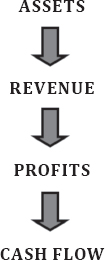 It looks simple, but what it really means is that you need to be very effective at acquiring assets that maximize and service revenue, then be very efficient at converting those revenues into profits, and finally be very productive at converting profits into cash flow. (View Highlight)
 At the end of the day, we want to minimize the monetary amount of assets required to produce the maximum amount of revenue. Once we have revenue, we want to minimize our expenses to maximize our profits. Finally, we want to maximize the cash that our profits produce. (View Highlight)
 Overspending on assets and expenses sabotages your business and financial success. (View Highlight)