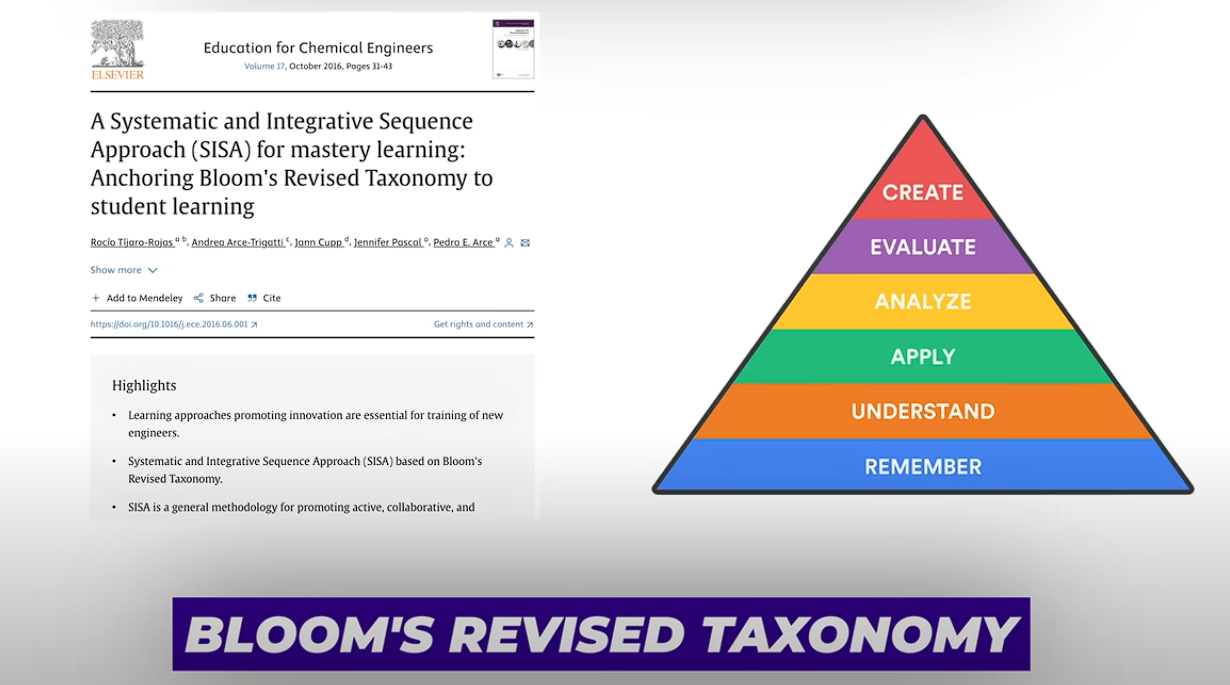
Quote: “if you want to use it , you should be able to answer how it works, if you want to modify it and improve it, you should be able to answer why it works”
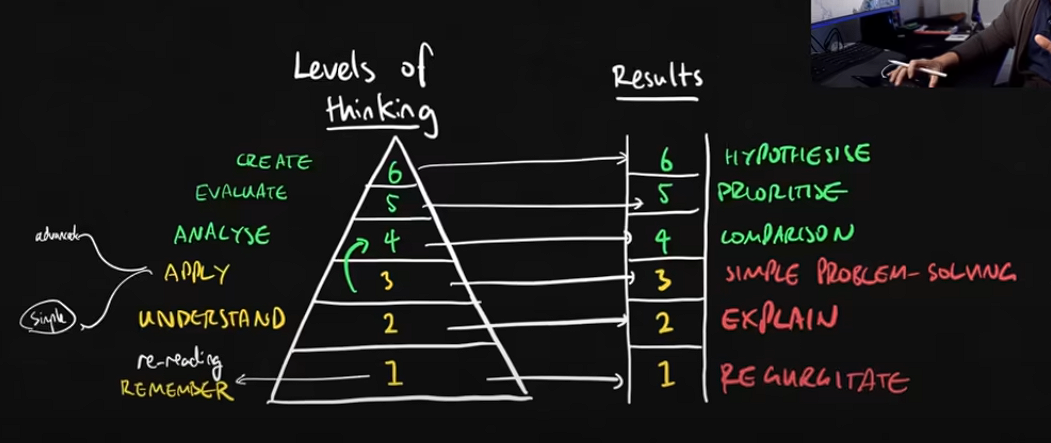
- Level 1:
- Threat: Knowledge Decay, due to Forgetting Curve
- Level 2:
- Level 3:
- Level 4: Compare and Contrasts
- We find similarities and differences, so we can evaluate, this provide us tools and assign values for us to justify our judgment on next level.
- Level 5: Evaluation and Judgment
- We evaluating and assessing solutions for provided problem, this require linear thinking for logical solution and requires system thinking for creative implementation. (implementation is asking where should we use it, which relies on why, while solution is asking how we do it, which relies on what)
- Level 6: Hypothesis and Create
- Mostly use-cases, most important for real-life, due to how world evolve around tinkering and trial-and-error.
Practicing Tips:
- Ask Chatgpt, give me questions at (stage of learning) for (subject) at Bloom’s revised taxonomy at (pick a level).
Reference:
🧠 The 6 Levels: Threats & Defenses
Here’s a look at the primary threat for each level of cognitive skill and the specific strategies needed to overcome it.
Level 1: Remembering
-
Goal: To recall facts, terms, and basic concepts.
-
Primary Threat: The Forgetting Curve. As you noted, this is the natural decay of memory over time. Information you don’t use, you lose.
-
Primary Solution: Active Recall & Spaced Repetition. This is the perfect tool for this job. By forcing your brain to retrieve information at increasing intervals, you are signaling that the information is important and actively fighting the forgetting curve.
Level 2: Understanding
-
Goal: To explain ideas or concepts in your own words.
-
Primary Threat: Shallow Understanding (The Illusion of Fluency). This is the danger of recognizing something without truly grasping it. You might read a chapter and think, “Yep, that makes sense,” but be unable to explain it to someone else. You mistake familiarity for comprehension.
-
Primary Solution: The Feynman Technique. To counter this, try to explain the concept in the simplest terms possible, as if you were teaching it to a child. This immediately reveals gaps in your understanding. Concept mapping and summarizing are also excellent tools here.
-
Heavy Testing and Self-Practice and Test/Certification:
- Using sites like Kaggle for Statistics, Boot.dev for Python, Leetcode for data structure and algorithm problem solving.
https://thedecisionlab.com/biases/dunning-kruger-effect
Level 3: Applying
-
Goal: To use information in new, concrete situations.
-
Primary Threat: Context Blindness (Failure to Transfer). This is when you know a rule or formula but can’t recognize how to use it in a slightly different context or a real-world problem. The knowledge is “stuck” in the specific context where you learned it.
-
Primary Solution: Interleaved & Varied Practice. The solution is to practice solving a wide variety of problem types that are mixed together (interleaved). This forces your brain to learn when and how to apply the knowledge, not just what the knowledge is. Case studies and simulations are perfect for this.
Level 4: Analyzing
-
Goal: To break down information into its component parts to explore relationships.
-
Primary Threat: Cognitive Biases. Our brains are wired with mental shortcuts that can lead to errors in judgment. Confirmation bias, for example, makes us see only the evidence that supports our existing beliefs, preventing impartial analysis.
-
Primary Solution: Critical Thinking Frameworks. To overcome bias, you must use structured thinking. This includes strategies like actively seeking disconfirming evidence, making pro/con lists, using reasoning models (like First Principles), and asking “What am I missing?”
Level 5: Evaluating
-
Goal: To justify a stand or decision; to critique.
-
Primary Threat: Unclear Criteria & Emotional Reasoning. We often make judgments based on a vague “gut feeling” or emotion rather than on objective, consistent standards. This leads to inconsistent and indefensible evaluations.
-
Primary Solution: Developing Rubrics & Using Mental Models. The best defense is to explicitly define your criteria before you evaluate. Creating a simple rubric or checklist forces objective thinking. Using mental models (e.g., the Inversion model, where you consider the opposite of what you want) helps you see the decision from multiple angles.
Level 6: Creating
-
Goal: To generate new ideas, products, or ways of viewing things.
-
Primary Threat: Mental Blocks & Functional Fixedness. These are major barriers to creativity. They include things like writer’s block, fear of failure, and “functional fixedness,” which is the inability to see an object or idea being used for anything other than its traditional purpose.
-
Primary Solution: Divergent Thinking & Idea Generation Systems. The solution is to engage in exercises that foster creativity. This includes techniques like brainstorming, mind mapping, SCAMPER (Substitute, Combine, Adapt, Modify, Put to another use, Eliminate, Reverse), or simply taking breaks to allow for diffuse-mode thinking where new connections can form.
🛡️ The True Role of Active Recall
So, to answer your second question: No, Active Recall is not the solution for everything, but it is the foundation for everything.
Think of it like building a house.
-
Active Recall is the process of mixing and pouring a strong concrete foundation (Remembering).
-
You cannot build the walls (Understanding), install the plumbing (Applying), or wire the electricity (Analyzing) on a weak or crumbling foundation.
You need to recall the core facts before you can understand them, apply them, or analyze them. Active Recall ensures the raw materials are available in your brain, but you need different, more sophisticated tools and blueprints to build the rest of the house.